Space Traffic Coordination
Space traffic coordination (STC) is the practice of reducing collision risk between maneuverable spacecraft by having their operators coordinate directly during a conjunction, rather than each acting alone.
Satcat provides tools for signaling maneuver intent, assigning responsibility, and preventing conflicting actions between operators. These features are built into conjunction assessment, so coordination happens where decisions are made.
From Management to Coordination
While Space Traffic Management (STM) frameworks define broad responsibilities, they do not provide a process for coordinating avoidance maneuvers. Most operators still act independently, even during high-risk conjunction events involving another active spacecraft.
With growing constellations and shared orbital regimes, that model is no longer sufficient. Operators must be able to communicate intent and understand the posture of the other party.
Coordination Features in Satcat
Satcat's coordination system follows the practices of the Space Safety Coalition, and is operationalized through Rules of the Road.
Key coordination features in Satcat include:
-
Maneuver Responsibility Assignment
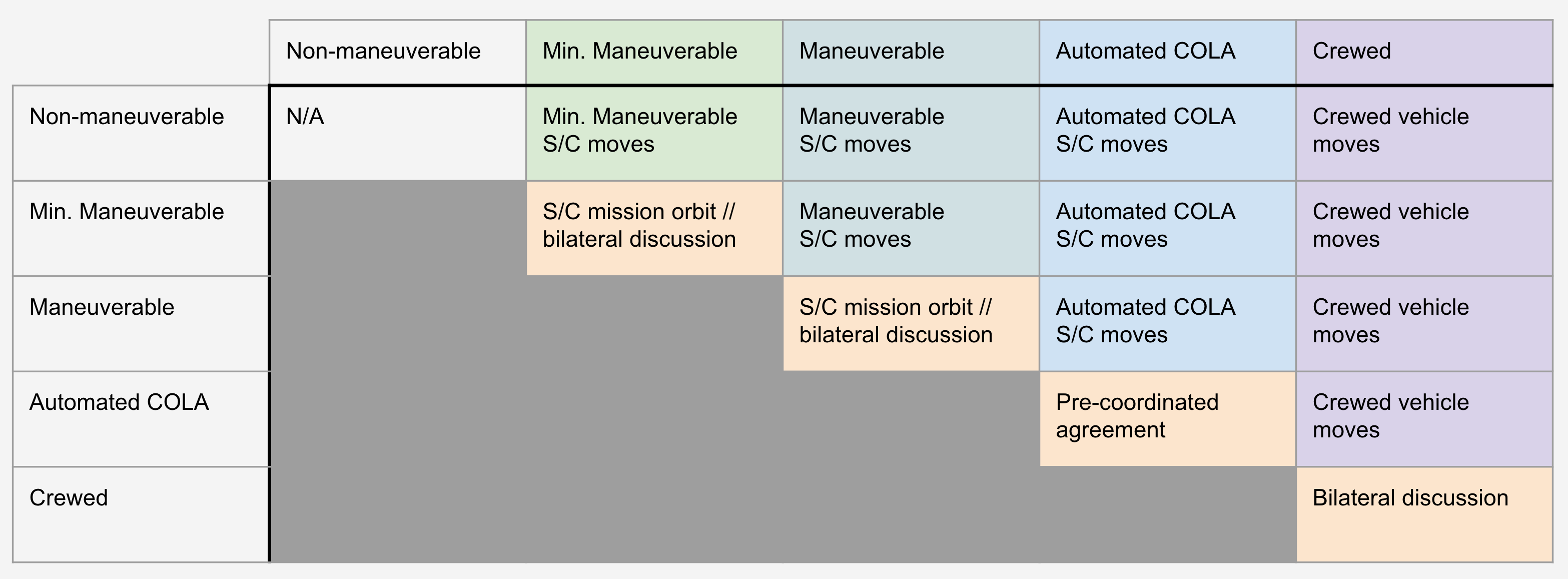
Satcat assigns responsibility based on the maneuverability category of each RSO, indicating which operator is expected to take action. -
Intent Declaration via Ephemeris Metadata
Operators communicate maneuver posture by uploading ephemeris with aCONTEXTvalue. Examples includeCOLAandROUTINE. -
Asynchronous Operator Coordination
Coordination is designed to occur with or without real-time interaction. Each operator can review, respond, and update their intent independently.
Maneuverability Categories
Satcat classifies every RSO into one of six maneuverability categories, following the SSC classes. The category determines which operator is expected to act in a conjunction.
| Maneuverability Category | Description |
|---|---|
| Non-Maneuverable | Total inability to effect flight safety relevant orbital changes |
| Minimally-Maneuverable | Only able to perturb one's orbit to a very small degree |
| Manually-Maneuverable | Able to easily alter one's orbit within a short reaction time |
| Auto-COLA Maneuvering | Maneuvering decisions are made without human intervention |
| Crewed | A spacecraft with inhabitants that are able to alter their orbit |
| Unknown Maneuverability | The spacecraft maneuverability is not known |
Where both spacecraft fall into the same category, neither is assigned responsibility and the operators coordinate bilaterally. The diagram below gives the assignment for every pairing.
For related details, see: